
#shorts
Philosophy is a subject I have been recently starting to seriously explore. I don’t feel knowledgeable enough to talk about philosophy, and I haven’t read many philosophy books, but of of the ones I did, I want you to read them because they were quite profound and changed how I see the world and myself in quite significant and remarkable ways.
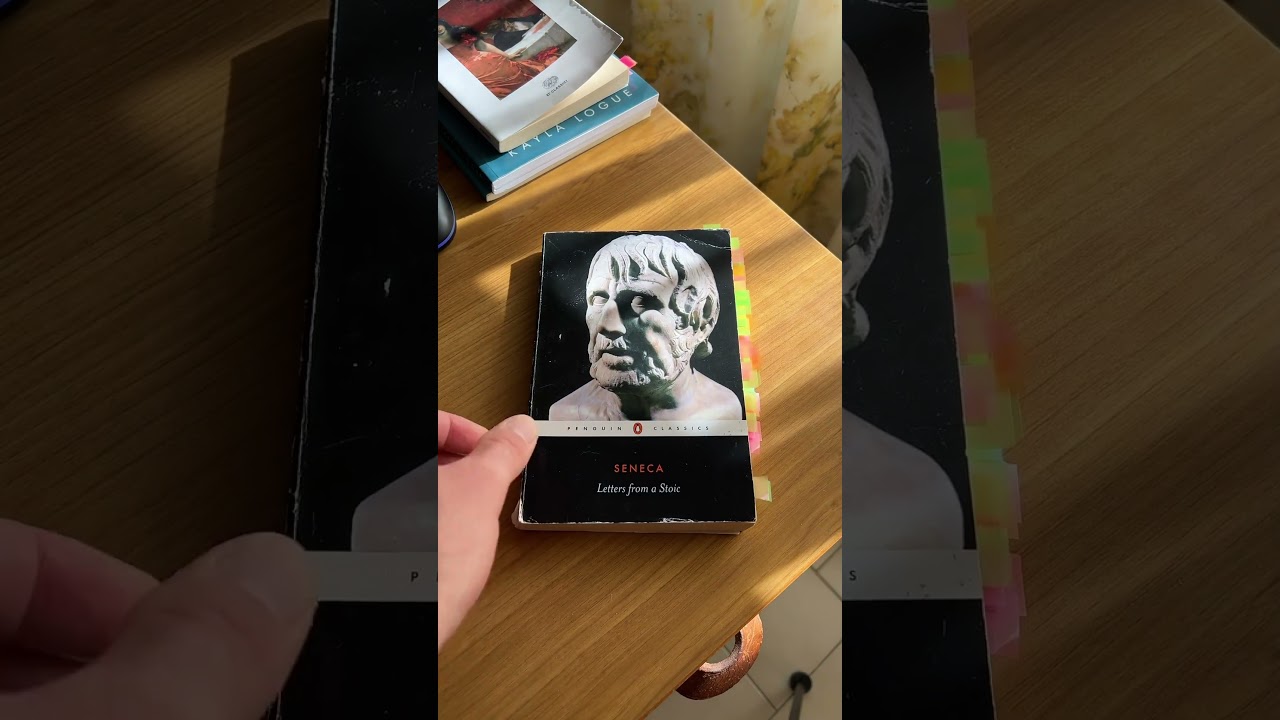
Featured books
1. The Construction of Social Reality;
2. Letters from a Stoic;
3. Discourses and Selected Writings;
4. The Will to Power;
5. The Denial of Death.
Would you like to add any other titles to this list
source


1. The Construction of Social Reality: https://geni.us/Owdx
2. Letters from a Stoic: https://geni.us/IuGmh2
3. Discourses and Selected Writings: https://geni.us/Uo50f
4. The Will to Power: https://geni.us/Qif9
5. The Denial of Death: https://geni.us/jReiv
En castellano por favor gracias
Old philosophy is outdated, because the progress of knowledge was much worst than now. They didn't knew thins that are known today, so they couldn't make correct thinking.
It's the first youtube short about books in which a book I've read is featured. I'm clearly reading all the wrong ones
Five amazing slops for feeding your pigs
1 . The construction of social reality
2 . Senica letter from stoic
3 . Epictetus discourage and select writtings
4 . The will to power
5 . The denial of death
1. This will not mean what it is intended to convey without being familiar with Baudrillard.
2. and 3. Stoic texts are less "philosophy" and more "philosophy of life" (though to distinguish these is contentious, it serves the current purpose…).
4. The Will to Power misrepresents Nietzsche's works. His sister and another put fragments together and imposed their own meaning on them that oriented it toward what eventually became a Nazi regime.
5. Pop-philosophy.
Bro give us the titals I can't look up covers
The Will to Power isn't a a great place to start with Nietzsche. It's literally just his notes compiled together posthumously. Beyond Good and Evil is a better place to start with Nietzsche.
Marcus Aurelius Meditations need’s to be aded!!!!
Marcus Aurelius
"Might is Right" by Ragnar Redbeard.
Bro read something from this century
You can skip all these. Read Hegel and Marx.
Bro sounds like pavel durov
You really snubbed Heidegger's Being and Time
The Conspiracy Against the Human Race by Thomas Ligotti
nihilism st seraphim rose, the tragedy of philosophy Sergei Bulgakov. these are contrast, one deep hungereing other intellectual insight harmonies in the critical.
ES posible confiar en el pensamiento de un filósofo que fue finalmente juzgado y despojado de su status académico?
Letters from a stoic 📈
Man's Search For Meaning
I would not recommend the Will To Power. I'd go with Beyond Good & Evil or Ecce Homo.
Beautifully done
These books actually do the opposite, especially Nietzsche.
Summa theologica
Theory of Mass Movements by Eric Hoffer
Don’t show the body of the person in the image. Have some modesty
it seem odd and probably isn't what you were expecting but you should really read steal like an artist, if made me re think my lift
The worldview advanced in The Denial of Death by Ernest Becker collapses under its own explanatory strategy because it attempts to reduce humanity’s orientation toward transcendence to a psychological defense mechanism while simultaneously relying on rational insight that presupposes the very faculties his reductionism undermines. Becker argues that religion, heroism, and moral systems are merely “immortality projects” generated by terror of death, however, this commits a genetic fallacy, explaining the psychological origin of a belief does not determine its truth value. If fear of death explains belief in immortality, then by parity of reasoning the same fear could equally explain the denial of immortality, thus the theory becomes self defeatingly symmetrical and loses explanatory force. More deeply, Becker’s account presupposes the reliability of rational analysis while simultaneously portraying human cognition as fundamentally distorted by existential terror, if our symbolic frameworks are primarily defensive illusions, then Becker’s own theory, produced by the same cognition under the same existential pressures, must also be interpreted as an immortality project masquerading as insight, which generates a performative contradiction the theory undermines the epistemic credibility required to assert it. Furthermore, Becker oscillates incoherently between a materialist anthropology (man as a biological organism) and a transcendent symbolic anthropology (man as a meaning seeking self that cannot accept annihilation). Yet on strict materialism, abstract meaning, normativity, and objective significance cannot arise except as evolutionary fictions, therefore Becker’s claim that humans legitimately seek enduring significance presupposes a metaphysical structure of reality capable of grounding such significance, precisely what his framework denies. Finally, his explanation of culture as symbolic immortality implicitly acknowledges that human intellect apprehends universal and trans temporal realities (truth, meaning, significance), but this capacity is unintelligible if humans are merely finite biological machines. Thus the theory collapses into an explanatory dilemma either human transcendence is real (in which case Becker’s reduction fails), or it is illusory (in which case his own philosophical critique, dependent on truth, rational insight, and normative judgment, is equally illusory). In either case, the worldview is internally unstable, epistemically self undermining, and metaphysically incomplete.
Are these easy read?
Reality constructs our social views, of a scientists for example who only absorbs and accepts the logic of nature and will freely accept concepts like eugenics and might makes right, just as much as very clever narrators that can construct a second reality by building social constructs. Either in order to oppress and dominate, or in order to protect from violence and fraud.
I like Augustine’s City of God.
Nothing content. Just listing books.
bros just listing random long philosophical books
Thus Spoke Zarathustra By Nietzche and The Republic By Plato As Well!
This book completely changed the way I think. Highly recommended!
slop
I need the book phil's-osophy
Cool books
Wow I was going to recommend the Denial of Death as that is a book I just finished twice. Did not expect to see it mentioned
Nice ❤
fyodor dostoevsky got some nice well dark books if thats more your lane
Most people know this intellectually but rarely practice it. That's the real challenge.
Weird picks.
All of these are child’s play 🍼 👶🏻